DeMaio Va, Alikhani Ma,b, Sangsuwon Ca , Abdullah Fa, Giovanetti Ma
Background: Three-dimensional (3D) printing is a rapidly advancing technology in the biomedical field. In relation to orthodontics, one use example for 3D printing is the fabrication of in-office appliances. Fabrication of in-office appliances, such as fixed appliances, can be both cost-effective and potentially more efficient due to the customization capabilities. In this study, the load-bearing capacity of 3D-printed materials was examined with the aim of comparing varying ceramic particle compositions.
Materials and Methods: In the first experiment, cylindrical rods with a diameter of 1.6mm were printed (n=15 per group) of 0% ceramic, 20% ceramic, and 50% ceramic. A three-point flexure test was conducted to measure the flexure modulus, mimicking the neck of a ceramic button. Utilizing the Instron Universal Testing Machine, a second test aimed to compare the shear bond strength at the bond interface of 3D-printed buttons bonded to resin maxillary premolars. Three resin compositions (n=15 per group) were examined: 0% ceramic, 20% ceramic, and 50% ceramic.
Results: When examining the results of the three-point flexure test, the mean maximum force withstood by the control, 20%, and 50% groups (in gF) were 1391 ± 9.03, 1428.50 ± 11.48, and 1934.29 ± 21.60, respectively. The results of the second experiment showed a statistically significant difference in the mean maximum force withstood by the three groups (ANOVA, p=3.92 E-6). There was a substantial increase in shear bond strength for the 20% ceramic group when compared to the control; however, shear bond strength decreased when ceramic composition increased to 50%.
Conclusion: Considering the results of the tests following the methodology employed, it can be stated that in-office printed ceramic appliances meet the mechanical requirements necessary for use in orthodontic clinics. Further research needs to be conducted to determine the saturation point at which ceramic concentration begins to negatively impact the shear bond strength of the printed appliance.
Innovation: It is promising that in-office 3D-printed buttons have the internal integrity to withstand intraoral application. This led us to conclude that the adequate concentration of ceramic particles in the resin allows us to print accessories with the mechanical conditions necessary for use in orthodontics.
Keywords: 3D printing, Intraoral appliances, Ceramic Buttons, 3D-printed appliances, Orthodontic Materials
Abbreviations: Three-dimensional printing (3D printing), Fused Deposition Modeling (FDM), Powder Bed Fusion (PBF), Stereolithography (SLA), Ultraviolet (UV), Liquid Crystal Display (LCD), Digital Light Processing (DLP), Shear Bond Strength (SBS)
Three-dimensional (3D) printing has changed dentistry, improving the quality of care and efficiency of clinical practice. The versatility of 3D printing technologies is applicable to benefit all dental specialties, which has been demonstrated through rapid innovations throughout the last decade.
In the fabrication of 3D objects, there are two main categories within which a process is categorized: subtractive manufacturing and additive manufacturing. Subtractive manufacturing is a process in which an object is produced by the removal of material from a larger structure, whereas additive manufacturing is the process of adding material successively to form an object. 3D printing utilizes an additive process, as these types of printers create objects by building successive layers upon one another, forming a three-dimensional end-product.
There are many additive processes that 3D printers utilize to fabricate 3D objects, such as VAT photopolymerization, fused deposition modeling (FDM), and powder bed fusion (PBF). Each of these processes has advantages and disadvantages in terms of their fabrication efficiency, device accuracy, and durability of the end product. For this paper, we will focus on the application of VAT photopolymerization and its application in the production of intraoral orthodontic devices such as buttons.
The roots of VAT photopolymerization technology began in 1981, when Dr. Hideo Kodama developed a device that hardens polymers utilizing ultraviolet (UV) light [1,3]. This became the backbone of many types of 3D printing technologies that utilize UV light to fabricate objects. Building off UV light polymerization, in 1986 Charles Hull developed and patented a stereolithography (SLA) machine utilizing UV light to cure polymers layer by layer to fabricate a solid object [2].
The material used for VAT photopolymerization printers is resin, which is a photoreactive liquid that hardens when exposed to UV light. These printers deliver the UV light to the resin via three main methods: SLA, Liquid Crystal Display (LCD), and Digital Light Processing (DLP). In simplest terms, these machines cure each layer of the photoreactive resin by the following means: SLA printers by utilizing a laser, DLP machines by utilizing a projector, and LCD machines by utilizing an LCD screen [3].
The resin used in 3D printing is composed of many different compounds. While the photoinitiator within the resin causes the material to harden when exposed to UV light, many additional compounds add to the structure, stability, and biocompatibility of the cured 3D object. One of these additional compounds, which is relevant for orthodontic purposes, is ceramic.
Fabrication of in-office appliances, such as fixed appliances, can be both cost-effective and potentially more efficient due to their customization capabilities [3,6,10,11,12]. The purpose of this study is to evaluate the structural differences of printable objects using resins of varying ceramic particle compositions. Analyzing the structural properties, such as load-bearing capability, is useful in determining the clinical application of 3D printable materials for orthodontic use.
Two tests were conducted to observe the behavior of printable resins. The first test (three-point flexure test) consisted of 45 samples divided into three groups of 15. These three groups consisted of 15 3D-printed cylindrical rods with a diameter of 1.6mm and a length of 20mm. The three groups differed in their concentration of ceramic particles within the resin: 0%, 20%, and 50%. The resin is as follows: 0% was printed using Liqcreate Bio-Med Clear resin, 20% and 50% were printed using resin that was a mixture of Liqcreate Bio-Med Clear resin and Senertek P-Crown V3 Ceramic. All materials printed were designed on both TinkerCAD and Meshmixer, and printed on the Anycubic Photon D2. After removal from the print bed, all rods underwent post-processing to remove excess resin. The rods were centrifuged at 5000 rpm for 10 minutes. After post-processing, each sample was aligned lengthwise on the Instron Universal Testing Machine with the center of the sample’s length at the machine’s arm. Once aligned, the force of application was zeroed before lowering the arm at 1mm per minute. Force over time was recorded until a spike in force drop was recorded due to sample breakage.
The second test consisted of 45 samples divided into three groups of 15. These three groups consisted of 3D-printed buttons designed to be bonded onto a 3D-printed upper 1st premolar. The groups differed in their concentration of ceramic particles within the resin: 0%, 20%, and 50%. The resin is as follows: 0% was printed using Liqcreate Bio-Med Clear resin, 20% and 50% were printed using resin that was a mixture of Liqcreate Bio-Med Clear resin and Senertek P-Crown V3 Ceramic, while all the premolars were printed using Anycubic Grey Water-Wash resin. All materials were designed on TinkerCAD and Meshmixer. The buttons were printed on the Anycubic Photon D2, while the premolars were printed on the Anycubic Photon Mono 2. After removal from the print bed, all materials underwent post-processing to remove excess resin. The printed buttons were centrifuged at 5000 rpm for 10 minutes, while the premolars were rinsed with water and fully dried. After post-processing, the buttons were bonded onto the center of the premolar’s crown using Dentsply Sirona Triad Gel and cured using the Imagitec bluelight LED curing light for 5 seconds on each of the incisal and gingival aspects. One-week post-bonding, the samples of each group were tested using the Instron Universal Testing Machine. Each sample was secured into the machine’s vice, and the arm was aligned at the neck of the button. Once aligned, the force of application was zeroed before lowering the arm at 1mm per minute. Force over time was recorded until a spike in force drop was recorded at 30% sensitivity. The button was designed to include nine pins within the base to aid in retention. After the breakage of the button from the premolar, each sample was examined under a microscope (AmScope SE306) at 20x magnification to count the number of pins from the button’s base that remained bonded to the premolar.
The results for the maximum force withstood by the rods and buttons were analyzed using single-factor ANOVA and Kruskal-Wallis tests. Additionally, each pair of groups in both tests was independently analyzed using a two-sample t-test assuming unequal variances. All statistical analysis was performed using Microsoft Excel version 16.78.3.
Maximum Force withstood by Rods
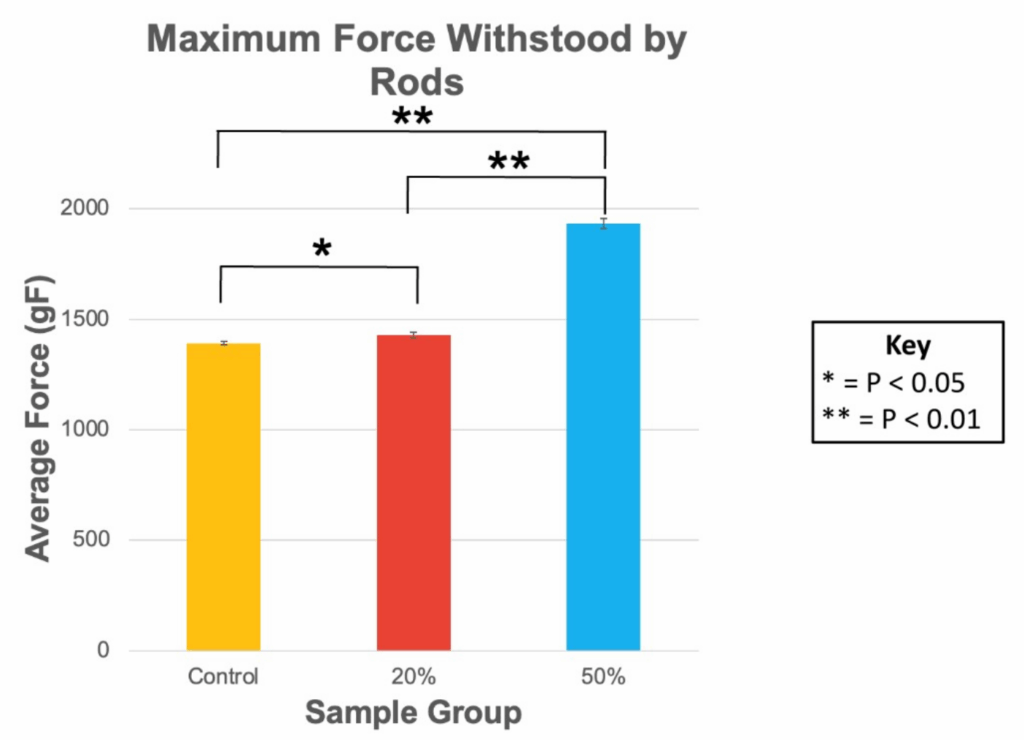
The mean maximum force withstood by the control, 20%, and 50% groups (in gF) were 1391 ± 9.03 gF, 1428.50 ± 11.48 gF, and 1934.29 ± 21.60 gF, respectively (Figure 1). There was a statistically significant difference between the maximum force of the two or more of the sampled groups (p = 3.44 E-28). T-tests showed a significant difference in the means amongst all paired groups (Control vs 20% p = 1.80 E-2), with especially strong differences between the control and 50%, and the 20% and 50% groups (p = 2.15 E-15 and p = 1.93 E-15, respectively). When examining the data utilizing the Kruskal-Wallis test, the results also reject the null hypothesis (p = 1.2 E-8).
This experiment was designed to resemble the force a button experiences from elastic polymers, eliminating confounding variables such as bond failure. The rod diameter was specifically designed to replicate the diameter at the neck of a ceramic button to ensure that the breakage point would be similar to that experienced on a ceramic button. According to a 2024 study testing three different manufacturers, Arifi, Emini, and Naumova-Trencheska found that the maximum intermaxillary elastic force delivered was 185.56gF [9]. Using this recorded force as a baseline for intermaxillary elastic force delivery onto a fixed appliance, 3D-printed buttons printed utilizing this protocol (neck diameter of 1.6mm) would be able to withstand in-vitro intermaxillary forces without breakage of the button [9].
Figure 1: The maximum force that rods of increasing ceramic concentration withstood was determined in a 3-point flexure test. Control and 20% resin samples were not significantly different, but both were significantly less than the 50% resin sample. Data represent mean ± sem of n=15 per group.
Maximum Force of Buttons Bonded to Maxillary Premolar
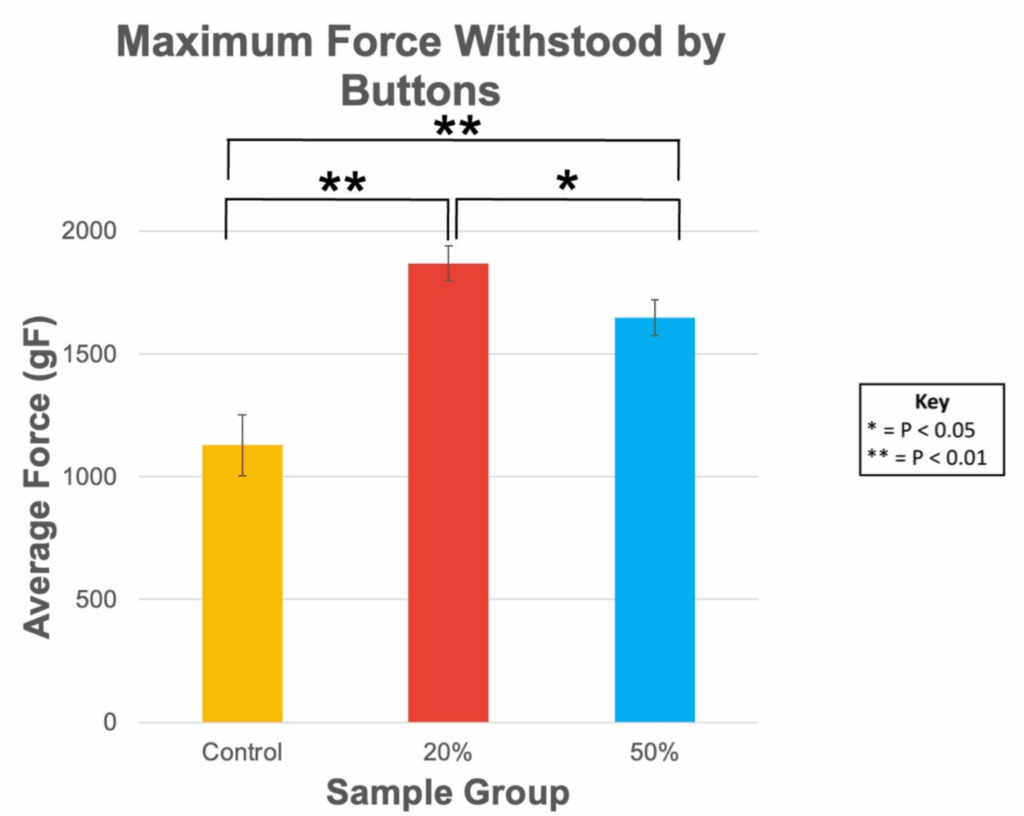
The mean maximum force withstood by the control, 20%, and 50% groups (in gF) were 1128.33 ± 124.49 gF, 1868.33 ± 69.72 gF, and 1646.91 ± 71.46 gF, respectively (Figure 2). ANOVA recorded a p-value of 3.92 E-6, signifying a statistically significant outcome. Each pair of groups were individually examined utilizing t-tests, and each pair demonstrated a statistically significant result (Control vs 20% p = 3.36 E-5, Control vs 50% p = 1.54 E-3, 20% vs 50% p = 3.49 E-2). Additionally, the Kruskal-Wallis test confirmed a statistically significant result, with a p-value of 2.8 E-4.
Intermaxillary and intramaxillary elastics are tools used to correct various malocclusions in all three planes of space: anteroposterior, transverse, and sagittal [7,8]. Buttons are a very versatile fixed appliance often utilized for this purpose. To ensure predictable outcomes, the fixed appliance must be able to withstand clinical forces without breakage of the appliance itself or debonding. In the first test, the 3-point bending test, we examined the capability of 3D-printed buttons to withstand clinical force without breakage. The purpose of this test is to examine the bond strength of 3D-printed buttons.
Figure 2: The maximum force that buttons of increasing ceramic concentration withstood before breaking off of a 3D-printed premolar was determined. The 20% and 50% resin samples were not significantly different, but both were significantly more than the Control sample. Data represent mean ± sem of n=15 per group.
The force a fixed appliance can withstand before debonding is typically known as shear bond strength (SBS). There are many factors to consider when examining the clinical applicability of an appliance since different bonding surfaces, such as enamel, acrylic, or porcelain, have different SBS [4,5,6]. The material used to produce the maxillary premolars is an acrylic-based resin, although the purpose of this experiment is not necessarily to determine the exact bond strength of ceramic to intraoral acrylics, such as temporized crowns. Instead, this test is aimed as a pilot to determine how increasing ceramic concentration may affect the shear bond strength either in a positive or a negative direction.
As shown in Figure 2, there was a substantial increase in shear bond strength for the 20% ceramic group when compared to the control; however, shear bond strength decreased when ceramic composition increased to 50%. This is a notable result, as it demonstrates two important findings. First, it shows that ceramic plays a significant role for increasing SBS as compared to a material that contains no ceramic. This is important when manufacturing fixed appliances, as it is a consideration to include ceramic to reduce risk of the fixed appliance debonding. Second, it is a significant finding that SBS decreases from 20% to 50% ceramic composition. This may indicate that there is a saturation threshold at which ceramic particle composition begins to negatively affect SBS.
Analysis Regarding the Number of Pins Bound
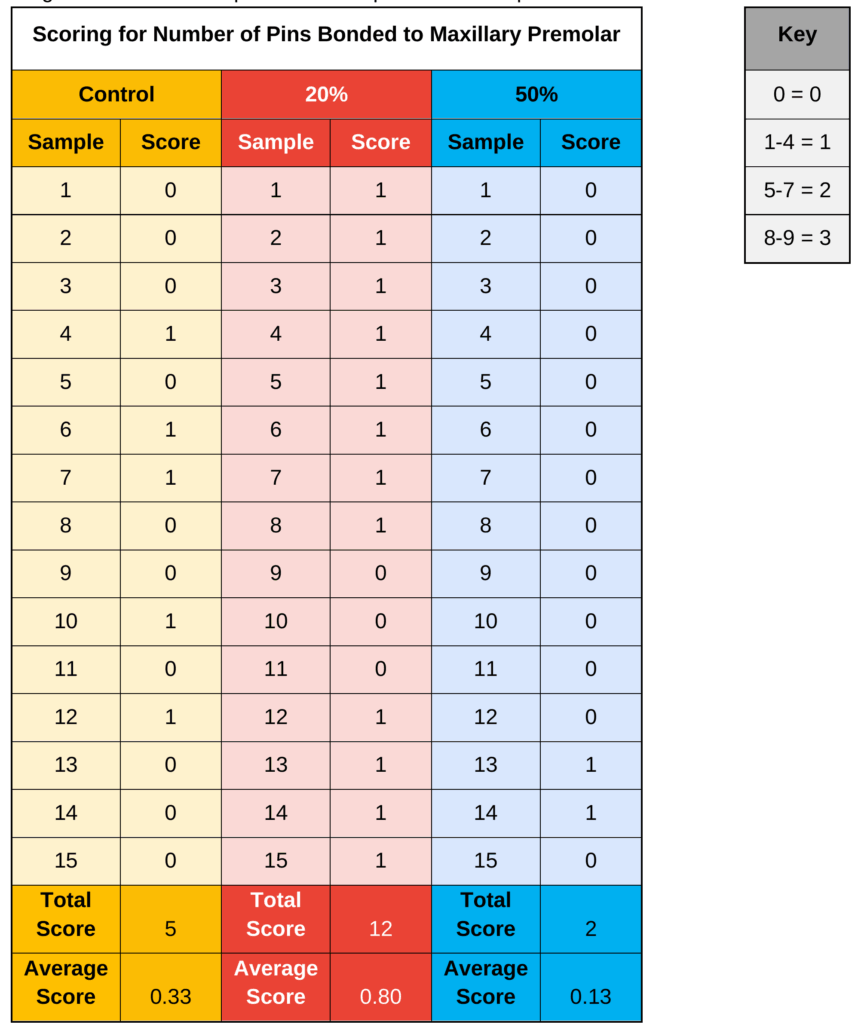
To confirm that the results presented in Graph 2 are truly measuring SBS, it is essential to determine that the site of failure is at the button-tooth surface rather than breakage of the button. To examine whether the point of failure was due to bond failure or button breakage, each premolar was examined under a microscope after its initial test under the Instron Universal Testing Machine. The buttons were designed with nine pins on the base to aid in retention; thus, each sample was scored based on the number of pins that remained adhered to the premolar after the experiment. The remaining pins were used to numerically score each sample as follows: 0 pins scored zero, 1-4 pins scored one, 5-7 pins scored two, and 8-9 pins scored three.
Table 1. Pins remaining on premolars after buttons debonded. The score represents the range of the number of pins that were present on the premolar.
The results in Table 1 show that the control, 20%, and 50% groups had summed group scores of 5, 12, and 2, respectively. Additionally, each sample averaged a score of 0.33, 0.8, and 0.13, respectively. With samples averaging a score below 1, it was determined that in most samples the site of breakage was between the bonding agent and the button or the bonding agent and the premolar, and not breakage of the button itself. Therefore, it is confirmed that the results of Graph 2 accurately represent SBS as recorded using this protocol.
As mentioned, the SBS test serves as a pilot in understanding the general trend between ceramic particle concentration and SBS. In this study, 3D-printed buttons were bonded to [acrylic] resin-printed premolars and bonded with triad gel, rather than bonded to enamel utilizing composite. The clearest area of future testing is to see if the trends established in this pilot study are consistent with circumstances more similar to in-vivo. Additionally, base design and printing layout should be considered as areas of future study, as these variables may impact the bond strength of ceramic fixed appliances to enamel [6,13].
Considering the results following the employed methodology, it can be stated that printed accessories with a higher concentration of ceramic load meet the mechanical requirements necessary for use in orthodontic clinics. However, other factors must still be observed in addition to the concentration of ceramic particles, such as the curing time per layer and, mainly, the design of the accessory.
1. Attarilar S, Ebrahimi M, Djavanroodi F, Fu Y, Wang L, Yang J. 3D printing technologies in metallic implants: a thematic review on the techniques and procedures. Int J Bioprinting. 2021;7(1).
2. Tian Y, Chen C, Xu X, et al. A review of 3D printing in dentistry: technologies, affecting factors, and applications. Scanning. 2021;2021.
3. Pagac M, Hajnys J, Ma QP, et al. A review of vat photopolymerization technology: materials, applications, challenges, and future trends of 3D printing. Polymers. 2021;13(4):598.
4. Pinho M, Manso MC, Almeida RF, et al. Bond strength of metallic or ceramic orthodontic brackets to enamel, acrylic, or porcelain surfaces. Materials. 2020;13(22):5197.
5. Urichianu M, Makowka S, Covell D Jr, Warunek S, Al-Jewair T. Shear bond strength and bracket base morphology of new and rebonded orthodontic ceramic brackets. Materials. 2022;15(5):1865.
6. Ansari MY, Agarwal DK, Gupta A, Bhattacharya P, Ansar J, Bhandari R. Shear bond strength of ceramic brackets with different base designs: comparative in-vitro study. J Clin Diagn Res. 2016;10(11):ZC64.
7. Farret MM. Orthodontic biomechanics with intermaxillary elastics. Dent Press J Orthod. 2023;28:e23spe3.
8. de Almeida MR. Current status of the biomechanics of extra-alveolar miniscrews. J World Fed Orthod. 2024;13(1):25–37.
9. Arifi A, Misevska CB, Emini VK, Naumova-Trencheska M. Evaluation of the force degradation of different types of orthodontic intermaxillary elastics at different time intervals–in vitro study. Knowl Int J. 2024;65(4):363–369.
10. Hodecker LD, Scheurer M, Scharf S, et al. Influence of individual bracket base design on the shear bond strength of in-office 3D printed brackets—an in vitro study. J Funct Biomater. 2023;14(6):289.
11. Papageorgiou SN, Polychronis G, Panayi N, Zinelis S, Eliades T. New aesthetic in-house 3D-printed brackets: proof of concept and fundamental mechanical properties. Prog Orthod. 2022;23(1):6.
12. Leonardi RM. 3D imaging advancements and new technologies in clinical and scientific dental and orthodontic fields. J Clin Med. 2022;11(8):2200.
13. Esmail Z, Wiltshire W, Pinheiro FH, Frota CM, França R. The effect of orthodontic bracket base shape on shear bond strength to human enamel, an in vitro study. Biomater Investig Dent. 2024;11:40585.