Sangsuwon Ca, DeMaio Va Teixeira CCa, Alikhani Ma,b
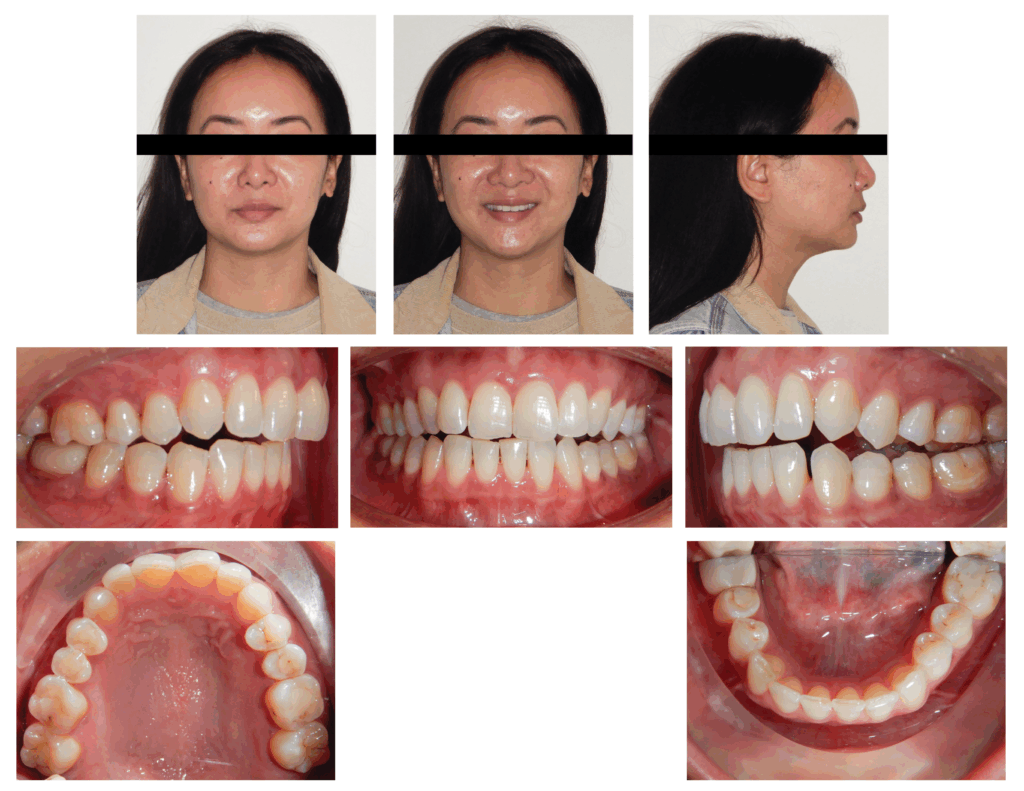
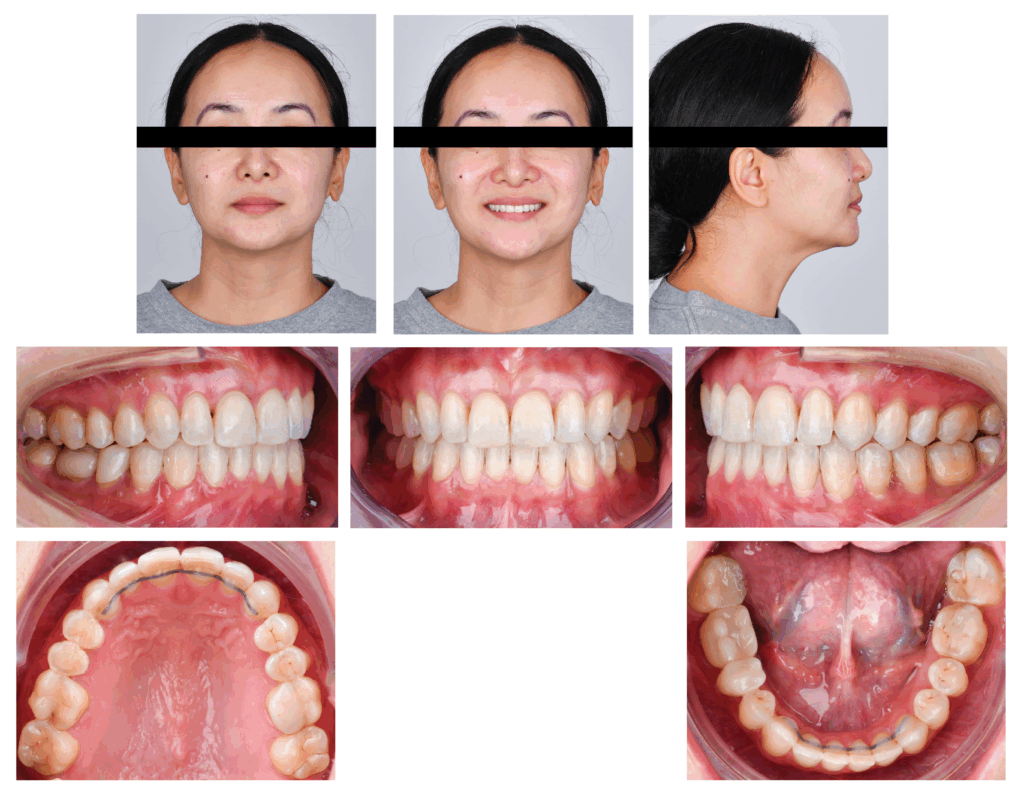
Figure 1: Pre-treatment portrait and intra-oral photographs. Frontal and profile views demonstrate a mesofacial pattern with a convex profile. Notable findings include mild facial asymmetry with the chin deviated to the right side and mild mentalis strain upon closing. The smiling portrait reveals a straight smile line with minimal buccal corridors and 60% maxillary incisor display, with no gingival display. The maxillary midline is coincident with the facial midline, while the mandibular midline is deviated 3 mm to the right. The maxillary arch is constricted and asymmetrical, resulting in an edge-to-edge relationship in the molar regions. Dental relationships show a full-cusp Class II on the right side and an end-on Class II on the left. A severe asymmetrical overjet (2 to 4 mm) is present, being more pronounced on the right side. An anterior and posterior open bite is observed, ranging from -1 to -4 mm from the upper right first premolar to the upper left second premolar. Multiple restorations are present, including a crown on the lower right first molar. Gingival recession is noted on the lower right second premolar and lower left lateral incisor.
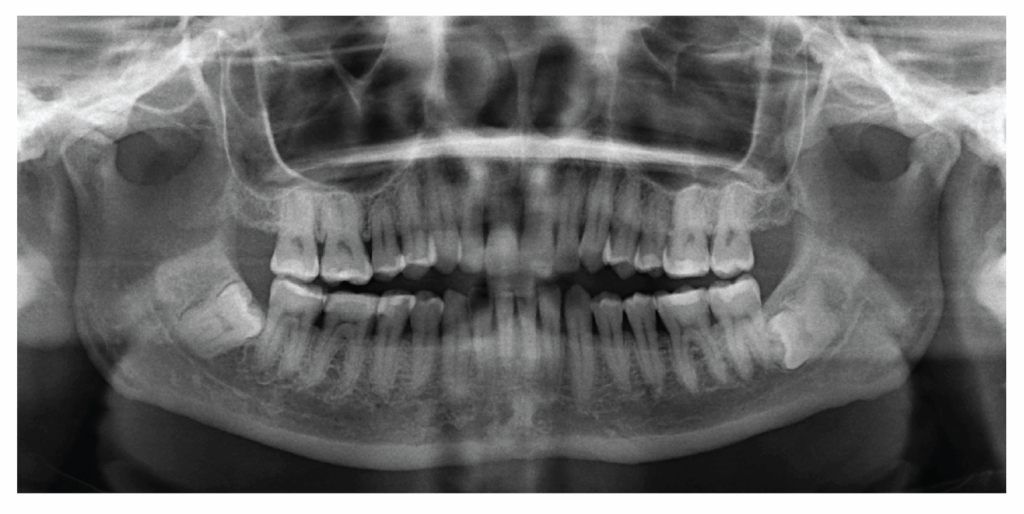
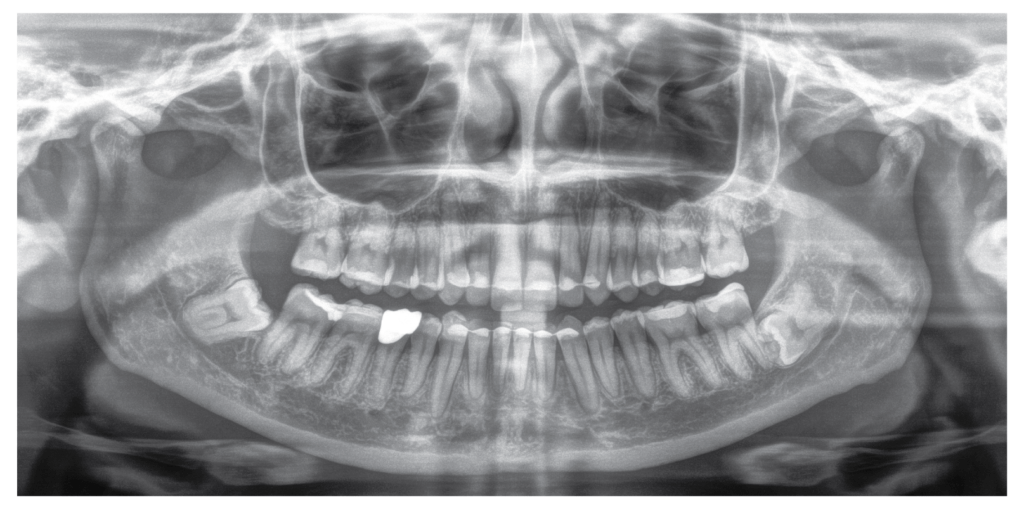
Figure 2: Pre-treatment panoramic radiograph. The panoramic radiograph reveals a complete dentition with 28 erupted permanent teeth and two impacted mandibular third molars. The roots of all teeth are fully developed, but there were signs of blunting on the maxillary second premolars. Remodeling of the condyles was also observed.
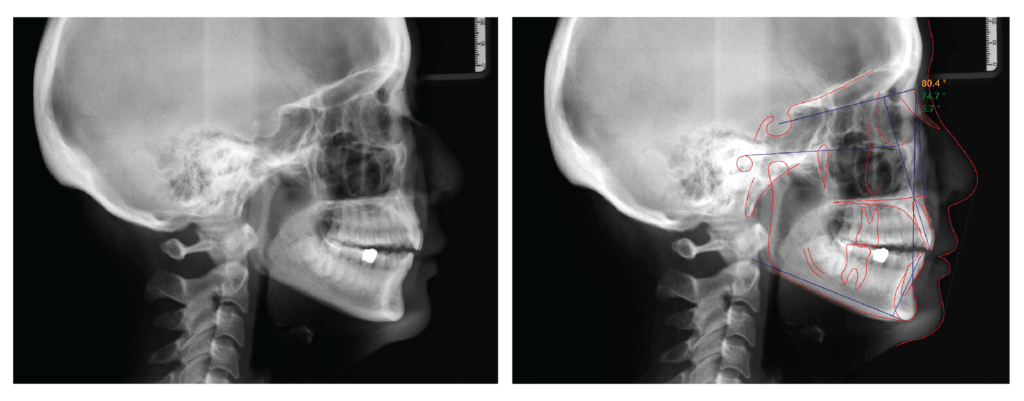
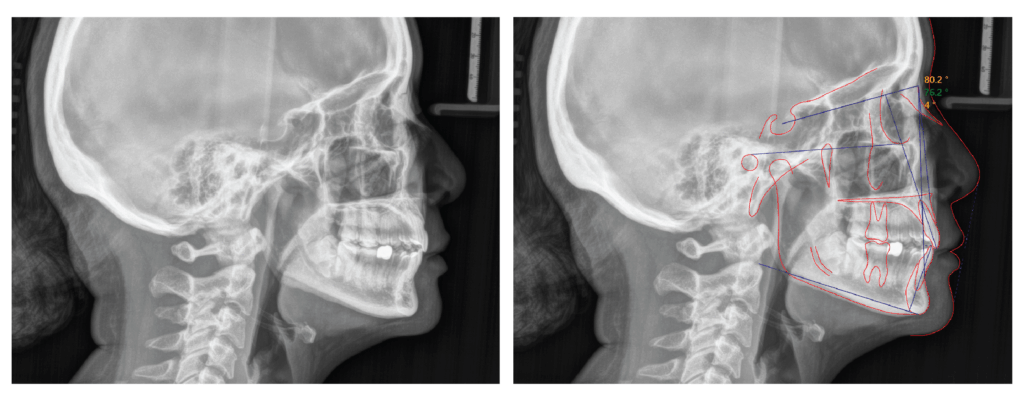
Figure 3: Pre-treatment lateral cephalometric radiograph. Pre-treatment lateral cephalometric radiograph shows a skeletal Class II jaw relation with counterclockwise rotation of the mandible and a retrognathic mandible. The maxillary incisors were slightly retroclined. The upper occlusal plane demonstrated counterclockwise rotation. Soft-tissue analysis indicated that the lower lip was slightly retruded. A crown was placed on the lower second premolar before initiation of treatment.
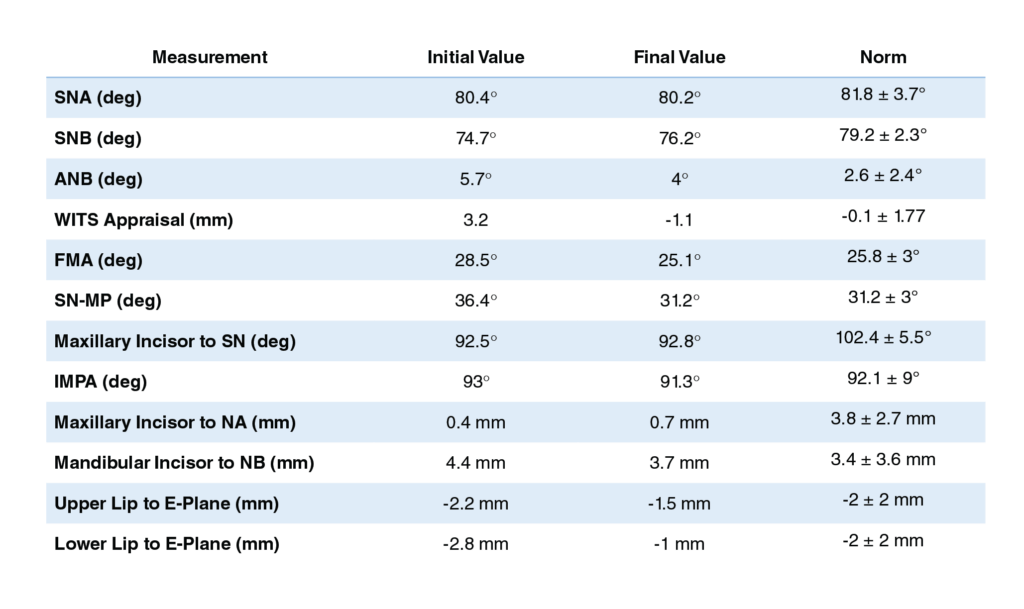
Table I: Cephalometric Analysis Pre- and Post-treatment. Angular and linear measurements were completed between craniofacial skeletal, dental, and soft tissue landmarks identified on pre- and post-treatment lateral cephalograms (° – degrees, mm – millimeters). Table shows initial and final values for this patient as well as expected normal values (Norm).
Figure 4: Post-treatment portrait and intra-oral photographs. Post-treatment photographs show a significant improvement in facial vertical dimension and profile through mandibular counter-clockwise rotation and correction of the mandibular shift, resulting in harmonized facial symmetry. The profile convexity and mentalis strain were successfully resolved, with an improved labiomental angle. Smile aesthetics were enhanced by correcting the open bite, achieving proper incisor display coincident with the smile line, and leveling the gingival margins. Intraorally, the patient presents a stable Class I canine and molar occlusion, corrected dental midlines aligned with the facial midline, and successful dental alignment. A normal overjet of 2 mm and overbite of 2.5 mm were established, with all posterior teeth in ideal and evenly distributed occlusion. Functional assessment confirms a mutually protected occlusion with cuspid-rise guidance and a healthy, asymptomatic temporomandibular joint.
Figure 5: Post-treatment panoramic radiograph. Panoramic radiograph at the end of treatment showed good root parallelism. Upper second premolars root blunting remains unchanged from the beginning of treatment.
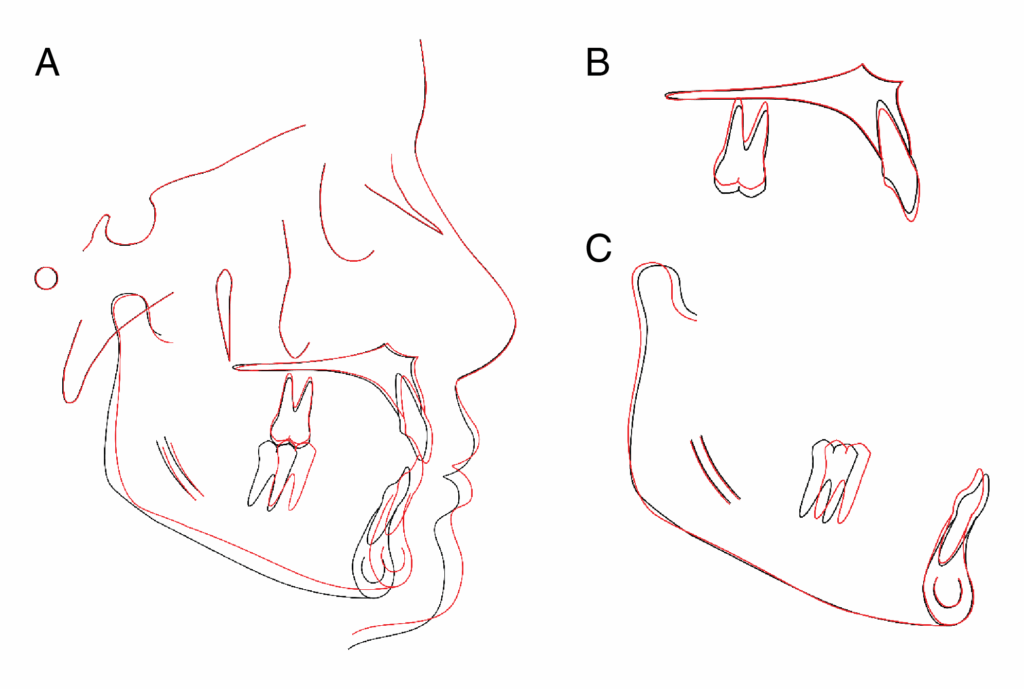
Figure 6: Post-treatment lateral cephalometric radiograph. Post-treatment cephalometric radiograph demonstrates a significant improvement in the sagittal skeletal relationship, with counterclockwise rotation of the mandible and clockwise rotation of the occlusal plane. Sagittal and vertical relation of the mandible in comparison with the maxilla significantly improved. Regarding dental inclinations, the maxillary anterior position was maintained while the mandibular incisors were slightly retroclined. These skeletal and dental changes significantly enhanced the soft-tissue profile, particularly the lower lip position.
Figure 7: Zygomatic bone in NM patients. 3D CBCT reconstruction of the (A) NM patient, (B) matched open bite patient, and (C) matched control patient. The orbital rim, zygoma, and maxilla body demonstrate thinner cortical bone and more porosity.
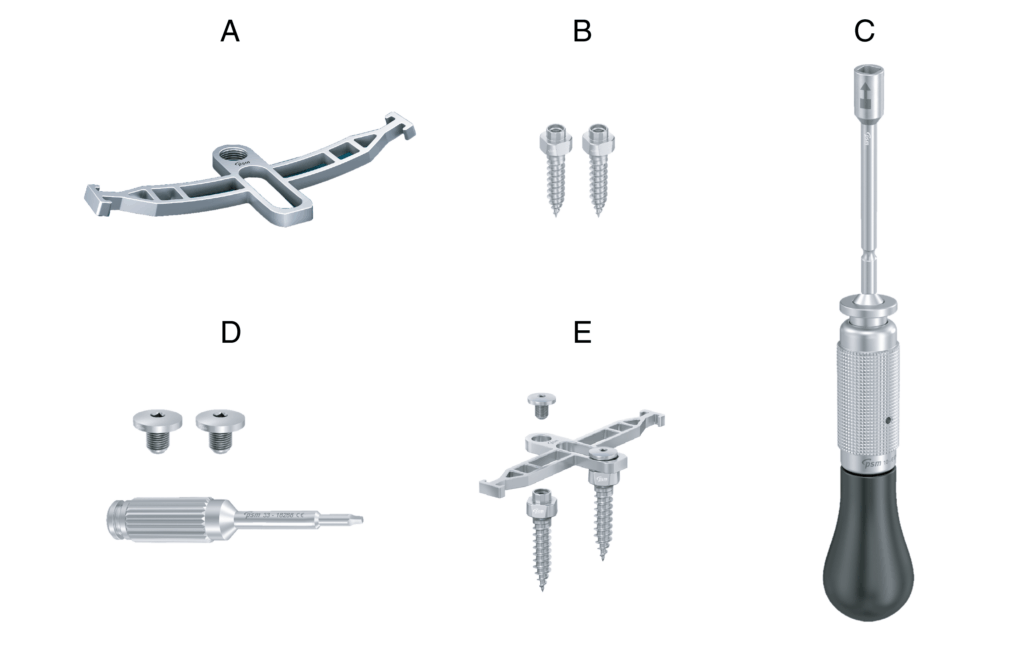
Figure 8: CTOR Plates and insertion kit. In this patient, we used a CTOR Intrusion Plate (A), secured to the plate with two TADs (B), 2 mm thick and 7 mm long. These TADs can be inserted by hand instrument (C) or a slow-speed motor. Capping screws were tightened to the TAD using a magnetic handheld screw driver (D) to secure the Intrusion Plates to the TADs (E). This system allows easy removal of the plate for necessary adjustments at a later time (psm-medical.com). There are several advantages to the use of external plates compared to the use of TADs alone, including better resistance to moments and forces that may unscrew or destabilize conventional single TADs
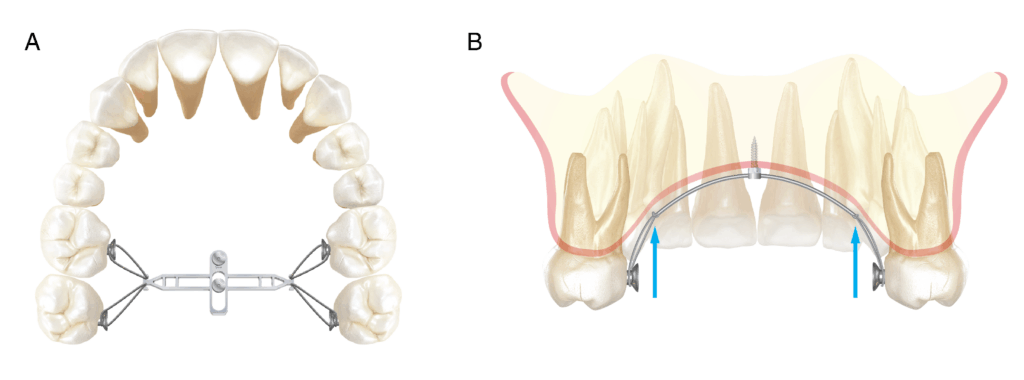
Figure 9: Schematic of CTOR Intrusion Plate used apply a force to the molars. Occlusal view schematic shows the external plate connected to the lingual buttons on the palatal surface of the molars using a power tread (A). This produces an intrusion force (straight blue arrows) close to the center of resistance of the posterior teeth (B) reducing horizontal forces applied to this teeth. Please note that these TADs have a small platform on their neck that stabilizes the external pate and prevents it from touching the palatal mucosa for improved patient comfort.
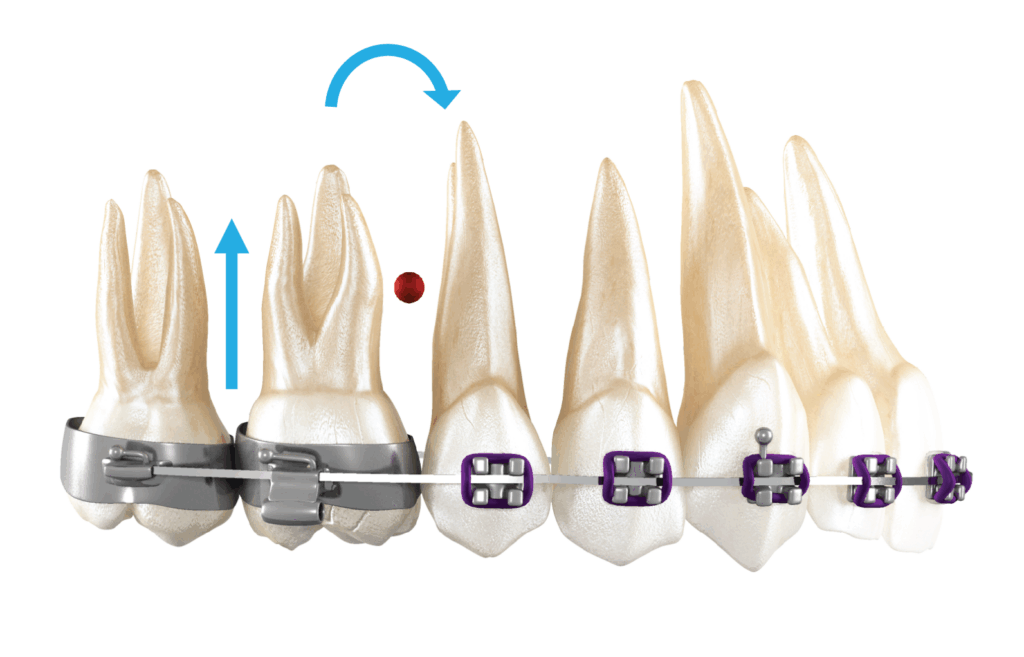
Figure 10: Application of intrusion force on posterior teeth by the CTOR Intrusion Plate produces a clockwise rotation of the occlusal plane. The palatal intrusion force (straight blue arrow) produced by the CTOR plate not only can intrude the posterior teeth, but can also cause rotation of the occlusal plane (moment represented by curved blue arrow). The effect depends on the number of teeth connected together in the dental arch, and where the center of resistance of the dental arch (red circle) is located in relation to the line of action f the force.